Reference Guide: Identifying Your Pallet Racking
Pallet racking comes in many styles. While there are numerous manufacturers, this guide will help you identify the most common models in Europe and on the French market.
With this guide from Matts Destockage, you can identify the most widely used systems, verify their compatibility, and make informed purchasing decisions.
How to begin identification?
To identify the style of your rack, inspect the connection points between the beams (horizontal beams) and the uprights (vertical supports).
Connectors: Observe whether the connection is made with clips (hooks), bolts, or safety pins.
Punching spacing: Measure the center-to-center distance between two holes on the uprights (generally 50 mm, 75 mm, or 76.2 mm in Europe).
Color: While not guaranteed, certain combinations (e.g., blue ladders and orange handrails) are typical of manufacturers like Mecalux.
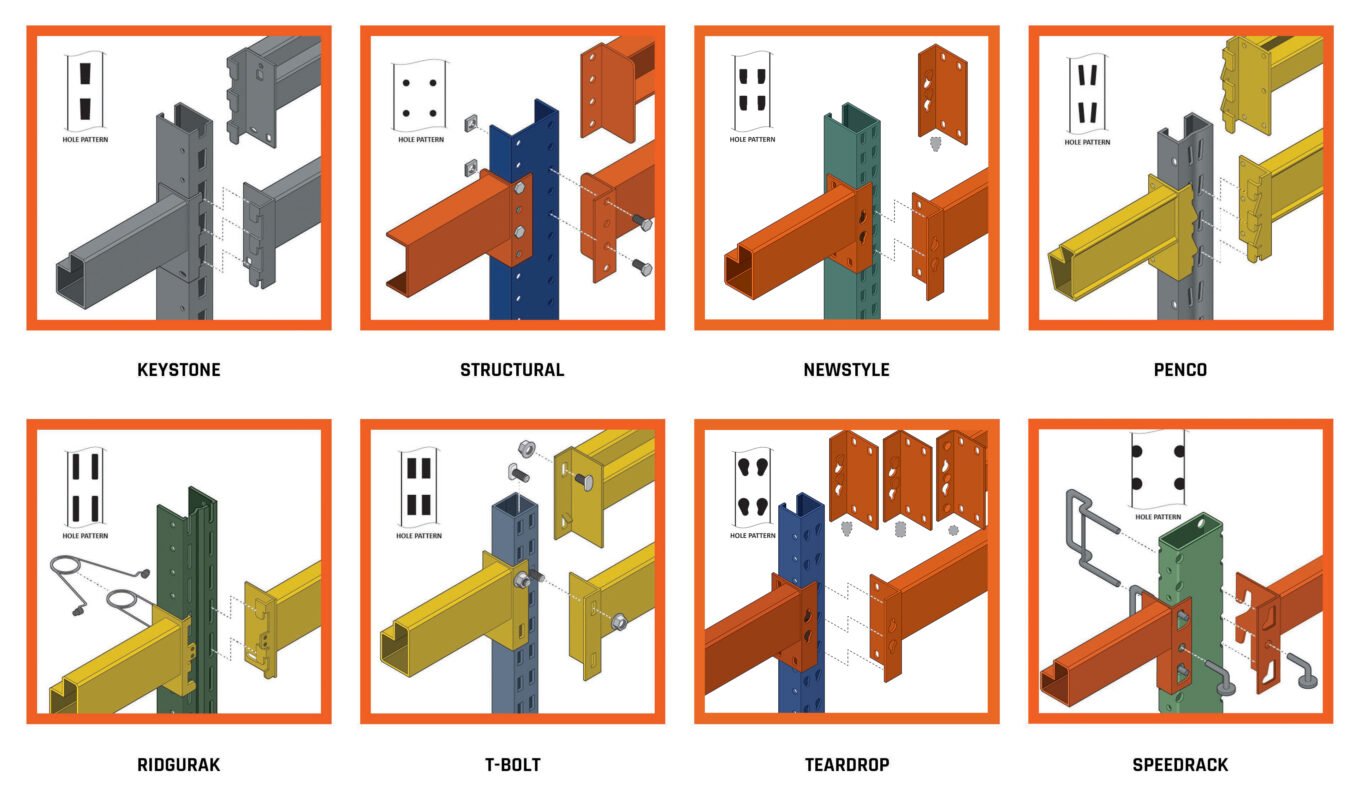
1. The Teardrop Style
Historically very common through Mecalux Interlake systems, the “Teardrop” style is recognizable by its inverted teardrop-shaped perforations.
Identification: The handrails have circular tabs that fit into the wider part of the teardrop before locking into place when lowered.
Use: This is a global standard, ideal for future upgrades. At Matts Destockage, we have a large stock of this model, both new and used.
2. The Standard European Style (Mecalux/Stow Type)
This is the most common model in France. The perforations are generally rectangular or H-shaped.
Compatibility: Note that although visually similar, a Mecalux connector is not necessarily compatible with a Stow or Dexion ladder.
Safety: These models require a safety pin (key) to prevent accidental detachment of the beam by a forklift.
3. Structural Style (Heavy Duty)
Designed for extremely heavy loads or environments with a high risk of impact.
Construction: Made of hot-rolled steel (U or C profiles).
Connection: Unlike claw systems, structural beams are bolted directly onto the ladders. This is the preferred choice for high-density outdoor storage areas or cold storage facilities.
4. Newstyle Style (Interlake New Style)
Often used in conjunction with the Teardrop system, the “Newstyle” features rectangular perforations with a slight downward bevel.
Advantage: It is often designed to be compatible with teardrop beams, which is a major advantage when purchasing used equipment to expand an existing warehouse.
5. Claw-Locking Racking (Penco/Ridg-U-Rak Type)
These styles use specific hook connectors.
Identification: The perforations on the uprights are often narrow, vertical slots. The beams have profiled claws that fit snugly.
Note: These systems are very robust but offer less interoperability between brands.
Style / Brand Connection Type No Drilling Main Use
Teardrop Pins / 50.8 mm (2″) Versatile & Scalable
Mecalux / EU Claws + Pin 50 mm / 75 mm Standard Logistics FR
Structural Bolts (1/2″) Variable Heavy Loads / Construction
Bolt-in (T-Bolt) High-Strength Bolts Rectangular Seismic Zones
This guide needs a significant “European pivot.” While the USA has many proprietary styles (Teardrop, Ridg-U-Rak), the European market is dominated by FEM (European Federation of Materials Handling) standards and specific brands like Mecalux, Stow, and Dexion.
For mattsdestockage.fr, we will frame this as an “Expert Guide” to help French buyers identify their existing equipment or choose the right system for European standards.
Reference Guide: Identifying Your Pallet Racking
Pallet racking comes in many styles. While there are numerous manufacturers, this guide will help you identify the most common models in Europe and on the French market.
With this guide from Matts Destockage, you can identify the most widely used systems, verify their compatibility, and make informed purchasing decisions.
How to begin identification?
To identify the style of your rack, inspect the connection points between the beams (horizontal beams) and the uprights (vertical supports).
Connectors: Observe whether the connection is made with clips (hooks), bolts, or safety pins.
Punching spacing: Measure the center-to-center distance between two holes on the uprights (generally 50 mm, 75 mm, or 76.2 mm in Europe).
Colour: Although not contractual, some combinations (e.g. blue ladders and orange slides) are typical of manufacturers like Mecalux.